
The Tlenamacac

On Saturdays I post samples of my creative writing. This an excerpt from my new book Bloodshed and Blessing—now available on my website as both hard copy an e-book. Go here.
The first half of the book consists of ten narratives of blood sacrifice down the ages—both human and animal sacrifice. The second half of the book explores what they meant to their participants and how the sacrifices pointed to Christ’s one, full, final sacrifice.
The reason I chose to put the book together like this was an attempt to get away from simply a dry, theological examination of the subject or an anthropological and sociological treatment of this fascinating topic. Instead, through the narratives I hope the reader might participate somewhat in the drama, the emotion, the terror and the hope that was locked into the ritual blood offerings.
If they could do so, they might once again connect more deeply with what is going on in that memorial of Christ’s one, full, final sacrifice that is called the Holy Mass.
So here is one of the chapters. The Tlenemacac —I had trouble pronouncing it when recording the audiobook!—is the terrifying sacrificing priest of the Aztec religion.
See what you make of it.
+++++++++++++++++++++++++++++++++++++++++++++++++++++++++
High atop the Templo Mayor in the heart of Tenochtitlan, the air was filled with the pulsation of drums and the piercing wail of conch shell horns. The great pyramid, its twin shrines dedicated to Huitzilopochtli, god of war and sun, and Tlaloc, god of rain, towered over the vibrant city.
The stone steps, slick with blood from countless offerings, glistened under the scorching midday sun. The Tlenamacac stood at the summit, his presence commanding the vast plaza below where thousands gazed upward, their dark faces filled with reverence and awe. Today’s sacrifice, a grand offering to expiate the people’s sin and ensure the sun’s eternal journey, would satisfy the gods of the Aztec people.
The Tlenamacac’s attire was a display of divine authority. His headdress, a cascade of quetzal feathers shimmering green and gold, crowned his head like a halo of sacred fire. A pectoral of polished obsidian, etched with the snarling visage of Huitzilopochtli, adorned his chest. A cloak of jaguar pelts draped his broad shoulders, the spotted fur rippling with each movement. Gold cuffs, embedded with turquoise stones, jangled softly around his wrists and ankles, catching the sunlight. His face, painted black with red stripes across his cheeks, mirrored the fierce countenance of the war god. In his right hand, he gripped a ceremonial obsidian knife, its edge honed to slice through flesh and bone with exquisite precision. Every element of his garb proclaimed his role as the intermediary between the mortal and divine—an intercessor between the gods and man.
The Tlenamacac reached into a bowl and put a handful of peyote buds in his mouth. As he chewed them he looked down from the pyramid where a line of young men stood naked, their bodies glistening with sweat under the relentless sun. Their skin was painted in bold patterns of black and red, the colors of war and sacrifice, marking them as offerings to Huitzilopochtli. Black stripes crossed their chests and limbs, while red spirals adorned their faces, symbolizing the darkness of death and blood— the life force they would give. Feathers—crimson and black—were tucked into their hair, which was shaved save for a single lock at the crown, a sign of their sacred selection. These captives, taken from distant tribes during recent campaigns, bore no chains; their acceptance of their fate reflected their conditioning and the Aztec belief in the honor of sacrifice.
The eyes of the captives, wide and glassy, flickered between resignation and terror as they awaited their turn. The crowd around them, a sea of nobles, priests, and commoners, chanted hymns to Huitzilopochtli, their voices rising like a storm. The young men’s painted bodies and feathered adornments made them appear as living effigies, their vulnerability an offering to the gods and their terror heightening the fervid communal emotions of the rite.
The Tlenamacac’s heart swelled with righteous anticipation. He believed these sacrifices were the lifeblood of the cosmos. The sun, he had been taught, was a warrior who battled darkness each night, requiring the mysterious strength of human hearts to fuel its journey. These deaths poured life back into the world keeping it alive and fruitful.
Without these offerings, the world would plunge into eternal night, crops would wither, and the gods would abandon their people. As Tlenamaca, his duty was to uphold this sacred pact. Each heart he offered was a plea for rain, a prayer for victory, a guarantee of the sun’s return. He felt a profound sense of harmony, his actions aligning the mortal world with divine will. His role as Huitzilopochtli’s chosen servant filled him with self-worth, a conviction that his hands, stained with blood, were instruments of cosmic balance.
The Tlenamacac continued to chew the dried peyote buttons as the cantor began to chant an invocation to Huitzilopochtli. The peyote infested and exalted his mind to a higher plain—a world of hallucinations where he left his body to commune with the gods. The peyote also strengthened him—as the dark gods took over his body, he was given the strength to perform his duty.
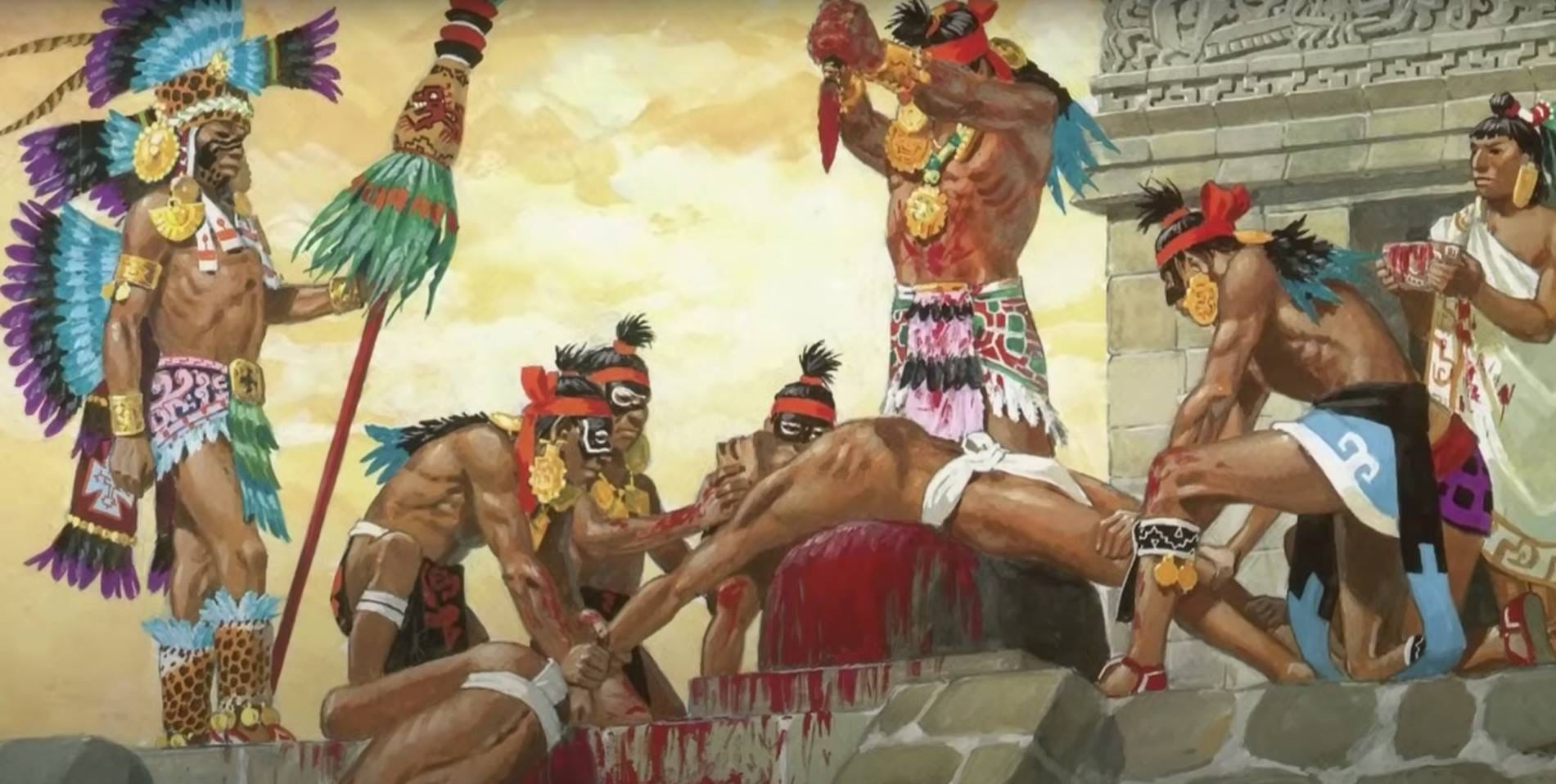
The brain-bent Tlenamacac stepped forward, his demonic movements deliberate, as the first young man was led to the altar. The captive’s painted chest heaved, the black and red patterns stark against his skin, his feathers trembling slightly. He did not resist as the priests stretched him across the convex stone, his back arched to expose his heart. The Tlenamacac raised the knife, his eyes meeting the young man’s for a fleeting moment.
He saw no plea, only a stoic acceptance that echoed his own resolve. With a swift, practiced motion, he plunged the blade into the man’s chest, carving through flesh and bone. Blood sprayed, warm and coppery, coating his hands as he reached into the victim’s chest to grasp the still-beating heart and tear it free. He held it aloft, its pulse a testament to his sacred duty, and the crowd roared, their voices a tidal wave of devotion. The heart was placed in a stone vessel, and offered up to the gods, while the body was cast across the platform to tumble down the pyramid’s steps——the head bouncing and arms and legs flailing as a gift to the bloodthirsty crowd. At the base of the pyramid altar, slaves flung it on a pile of corpses, blood seeping into the earth.
The Tlenamacac grimly chewed the peyote getting higher and higher under the drug’s hallucinatory power. One by one, as the afternoon burned on, the young men met their fate. The Tlenamacac ’s movements were steady, his mind a litany of prayers. Each heart, each life, was a brick in the foundation of the Aztec world. The crowd’s fervor grew with each sacrifice, their chants drowning out the faint gasps of the dying. The steps of the Templo Mayor ran red, the air thick with the metallic tang of blood and the sweet smoke of copal incense. The Tlenamacac’s thoughts remained fixed on his purpose: to expiate the people’s sin, to appease the gods and secure prosperity—but also to achieve union with the gods. The pyramid was his attempt to get up as high as possible to the realm of the gods. The peyote elevated his mind to the other world, and as he was drenched with human blood he was drenched in the life force of the cosmos.
With each heart offered, he felt Huitzilopochtli’s favor and the thrill of murder became a kind of ecstasy that took him to the threshold of the palaces of the gods. After the slaughter, the aftermath unfolded with ritual precision. The bodies, their black and red paint now smeared with blood, were collected by priests and prepared for distribution.
Some would be consumed in cannibalistic feasts, in which the revelers ingested the young victim’s strength and virility along with his body and blood. Others would be flayed, their skins worn by priests—attempting to clothe themselves in the youth and vigor of their victims. The hearts were placed in ornate vessels and burned in braziers, their smoke carrying prayers and the power of the victim’s young lives to the heavens.
As the afternoon faded into twilight, the Tlenamacac descended the pyramid, his cloak stained with blood, his headdress radiant. He paused at the base, gazing across Tenochtitlan’s canals, temples, slums and markets. He felt a surge of pride: the sun would rise tomorrow, the rains would come, and his people would endure, thanks to his unwavering service.
In his private quarters, The Tlenamacac removed his regalia, the obsidian pectoral warm against his skin. Alone, he knelt before a small shrine to Huitzilopochtli, offering a final prayer. The sacrifices had been made, the cosmic balance restored and he had, for a moment dwelt among the gods.
++++++++++++++++++++++++++++++++++++++++++++++
Go here for your copy of Bloodshed and Blessing. Readers of the substack feel free to ask for a signed copy. Use the “notes” box in the purchase process to do so and to request an inscription if you wish.
A reminder that all the content on my substack is free. We hate paywalls! However, if you want to take on a paid subscription to support my writing you may, and if you want more of my content, then over at my website is over twenty years’ worth of archived blogging—most of it free. There is a subscription opportunity there also if you want to access some of the extra content: audio, video and archived articles posted there from other outlets.
Amazing how even all the worst sacrifices of man held deep meaning as man's spiritual nature requires him to find it.
Whew that was grim! I’m impressed with how well written it was, sent chills down my spine. Glad the Spaniards were able to liberate them from such violent practices.