

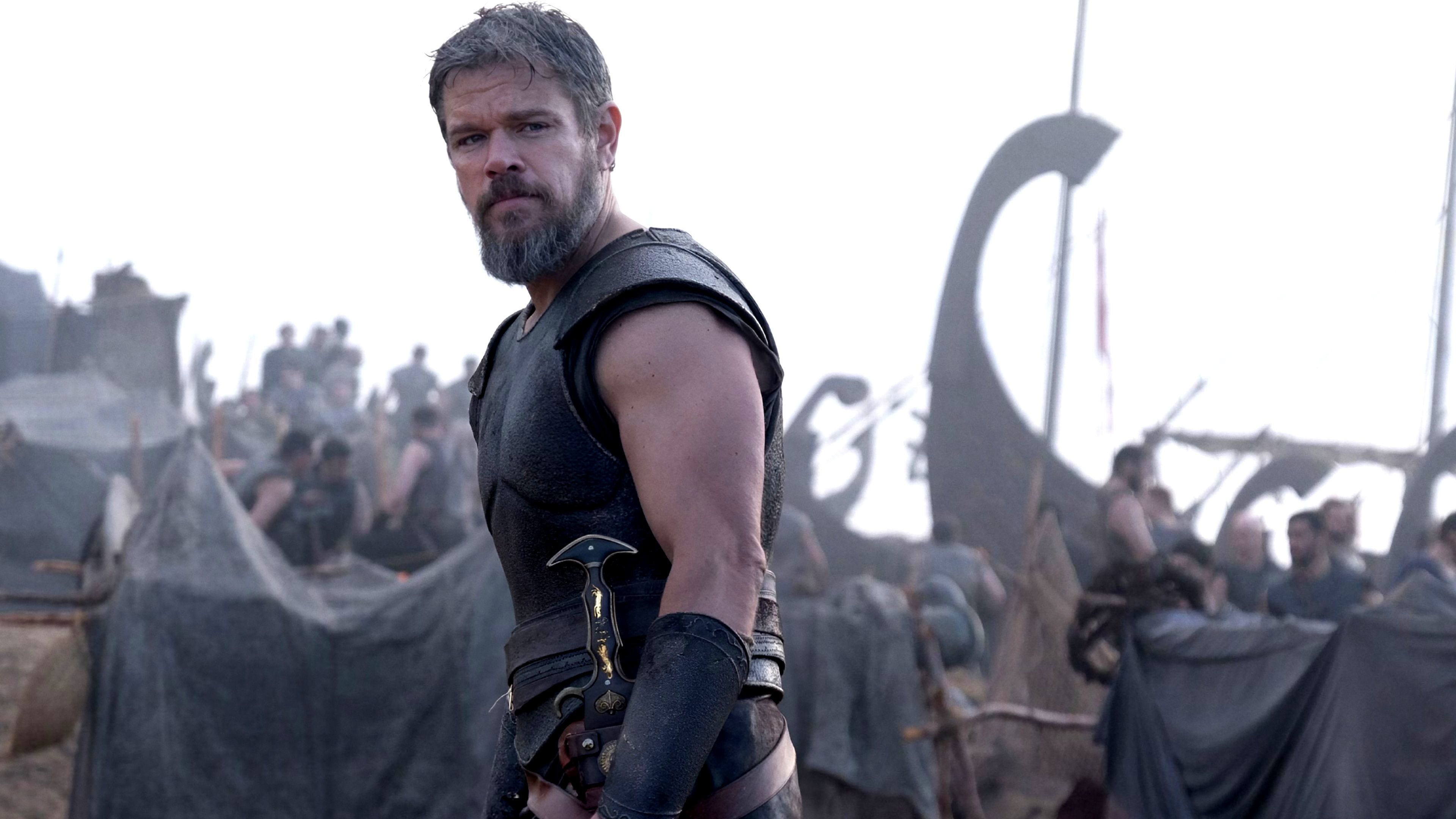
I finally went (with our son Elias) to see Christopher Nolan’s Odyssey yesterday. I don’t share the criticism of the online grumblers. Nothing like armchair film directors to poison the conversation. Yes, the film is not totally faithful to the book. So what? Films never are completely faithful. They are not meant to be. They are a separate art form not just a literal picture by picture word for word rendition of a much beloved text. This is the way dramatic art works. It is a team effort. One person has an idea. They write a book or a script. Another person interprets, and in doing so brings his own imagination and experience to the story and brings it to life in a new way. It’s part of the creative process and it happens all the time and it’s okay.
We heard the same sort of nit picking and grumbles over Peter Jackson’s Lord of the Rings trilogy. Ho hum. In fact, when you think about it, this process goes on whenever the creative process is happening. A painter is influenced by the stories, art and culture that has gone before him. He uses it and reimagines it—sometimes successfully often not.
One of the good things to come out of Nolan’s Odyssey is the fact that this wonderful story has been made accessible to a huge audience and thus helped to maintain and nurture the deeper and more ancient roots of our Western culture. Bravo. It’s a great film. If you get to see it in an IMAX theater book your tickets and go.
The whole thing is a powerful, sumptuous, exciting and moving tour de force.
Elias and I had some good discussions about the film on the drive home. He saw the Christian references and appreciated the deeper signs and symbols in the work. “Christian references??!!” I hear you say. “This was written in the eighth century BC by a pagan. Christian? Come now.” I knew that already. But we believe that the truths of Christianity lay hidden in the depths of the universal experience, and that pre-Christian culture and religion held within its dark depths the truths that would eventually be revealed in Christ the Light. This is the theme of my just recently released book Bloodshed and Blessing. Here is an excerpt from the introduction:
But links with pagan religions raise another question. Protestants and atheists like to point to the pagan antecedents of Catholicism as evidence for, at best, its inauthenticity and at worst, its diabolical origin. Does the similarity of the ancient religions to Christianity somehow undermine or challenge the Christian claims? Gil Bailie has observed that, “Archaic religion was both the absolute antithesis of Christian salvation and a crude groping towards it.” “Groping” was a good way to put it because the ancients were blind to the fulfillment that Christ’s sacrifice would one day enlighten the world. Or to put it in the terms of the poem that prefaces this book, Christ’s death is the “full final sacrifice on which all figures fixed their eyes,”
Once he accepted the Christian faith, C.S. Lewis said he was not disturbed by Christianity’s congruencies with ancient religions. In his book on Miracles Lewis wrote, “We should not be surprised to find among the religions of the world a preliminary pattern of truth, a kind of divine echo. I would not be troubled if the resemblance between Christianity and Paganism were much greater than it is. I would be more troubled if it were less.
Tangent: Bloodshed and Blessing will be available through my website bookstore very soon.
Do we read Christianity back into pagan culture like the person who sees a steamship a camel and an elephant in the cloud formations as he lies on his back gazing at the summer sky? Is this a case of pareidolia —like seeing Mother Teresa’s profile in a piece of burnt toast? Not really. It is tracing the deepest, universal truths—what C.S.Lewis called the “Tao” within wider human experience and culture.
Saying that, it was cool to talk with Elias about how the seven deadly sins were pictured in the Odyssey. They were portrayed in the different trials Odysseus and his men faced in their journey. As such, the Odyssey became an allegory for our journey through this valley of temptation.
So you could say the Cyclops symbolized the deadly sin of Pride. He was gigantic, omnipotent but alone in his darkened cave—surrounded by dumb sheep his followers. With only one eye he was limited to the singular vision only of himself.
The sin of gluttony was typified by the crew’s encounter with the witch Circe. We see the hungry sailors gorging themselves before she turns them into pigs. A very visual and visceral portrayal of gluttony.
In the land of Lamos the crew are attacked by the Laestrygonians—cannibalistic giants. They are thus the victims of wrath for wrath consumes oneself and one’s own in the fury of murderous rage.
On the island of Thrinacia the crew yield to the temptation of greed when they steal Helio’s cattle for their own.
The sirens typify the temptation to lust while the lotus eaters symbolize sloth.
Finally, envy — the root of all relational sin—is at the foundation of the story. Mimetic desire motivates the capture of Helen, the siege of Troy, the siege of Ithaka by the suitors, the threatened coup and marriage of Penelope by Antinous.
So the Odyssey can be read as a kind of pilgrim’s progress—-with its fantastic nightmarish sequences—a dream journey even. Thus the opening words of Pilgrim’s Progress:
As I walked through the wilderness of this world, I lighted on a certain place where was a Den, and I laid me down in that place to sleep: and, as I slept, I dreamed a dream
That the whole story reads like a dream is a reminder of the depths of the human experience we plumb with myth. Myth takes us into the liminal region—the borderlands of this world and the next—the place of chaos and crisis—there be dragons and this is where the wild things are.
Christian teachers of the classic, might therefore glean supportive meanings from the text, and not simply by using it as a morality tale to learn about the seven deadly sins. Instead it takes us into the depths. In seeing more to the story I’m reminded of a comment from film maker Steven Spielberg who was asked if the crosses in the cemetery in Saving Private Ryan were a sign that his hero was a Christ figure who “came to seek and to save that which was lost.”
Spielberg smiled and said, “I’m always fascinated to learn about the things people see in my pictures that I never knew about.”
I agree with what you say, that it is an adaptation, and all adaptations well, adapt, the source material. No one should wonder about that. Film and poem are different means of telling a story. I just found the film vacuous and boring - at three hours far too long, and the characterisation and plot very thin. Saying that I did not even notice the trans actor, not did I care about Helen being black, or many of Odysseus crew being Asian. I did care about them being a tad old, though..... they did not look like Greek heroes to me, more like a senior club's not very well organised and disastrous day out. But hey, that is just me, ageist! (Yes, I know Odysseus has a 20 year old son, but in the world of the poem he acts like and looks like a young hero.... why else did Calypso detain him for 7 years, or Naussicaa find him so charming?)
I think it is safe to say that if there was a Christ figure hinted at in "Saving Private Ryan," it is by the works of the Holy Spirit and not by the intentions of Steven Spielberg, who is as anti-Christian as they come. :)